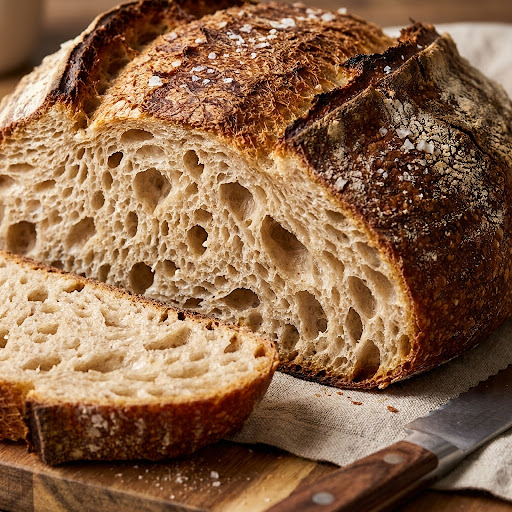

Artisan vs Sandwich: Proofing Tests
When the poke test works — and when dome and jiggle matter more
Both loaf styles answer the same question: Is the dough gassy, warm enough, and still structurally sound? On artisan loaves, the poke test is your main signal. On sandwich loaves, it is a confirmatory check after dome and jiggle — and almost useless on a cold, flat puck until the dough warms and rises.
The short version
| Artisan (boule / batard) | Sandwich (pan loaf) | |
|---|---|---|
| Primary test | Poke test — slow fill-back (~15–20 sec) | Dome + jiggle — crown above rim, whole mass wobbles |
| Secondary | Volume gain, surface tension, gentle wobble | Poke on the center of the dome only |
| What you’re reading | The whole exposed surface | How the dough fills the pan |
| Shape effect | Free to spread → poke behaves predictably | Confined → can’t spread, so indent is misleading |
| Under-proofed | Poke snaps back fast; tight, small, no jiggle | Flat to rim; stiff; no crown; zero jiggle |
| Ready | Poke fills slowly; slight jiggle; looks puffy | Clear dome over rim; soft shoulders; gentle wobble |
| Over-proofed | Poke stays dented; may look slack or weepy | Collapsed dome; may sink; sticky surface |
Artisan loaves — poke test is primary
On a boule or batard, the dough is free-standing — gas pushes outward and upward, so the surface reflects internal pressure. The crust is usually thin and soft at proof time, so your finger reads the dough, not a hard skin. One poke in the center is representative of the whole mass.
Classic artisan sequence
- Volume — look for ~30–50% gain from shaped size.
- Jiggle — gentle shake; the whole loaf moves as one piece.
- Poke — press the center with a floured finger.
- Bake when the indent slowly rebounds (~15–20 seconds).
Trust poke when
- Dough is at room temp (not straight from the fridge).
- Surface is soft — not a dry, cold puck.
- You’re poking the belly, not a seam or score line.
See our How to Shape Bread guide for boule and batard techniques before final proof.
Sandwich loaves — dome and jiggle first
In a pan, the loaf can’t expand sideways — only up. A poke doesn’t tell you if the corners are filled or if the whole block is alive. The top skin can be dry or firm (fridge, oiling, scoring) while the inside is still cold or sluggish. You’re often checking geometry (did it crown?) more than spring-back.
Classic sandwich sequence
- Dome — crown rises clearly above the pan rim.
- Jiggle — shake the pan; the whole mass wobbles as one unit.
- Poke (optional) — only on the softest part of the crown, as a tiebreaker.
- Bake when dome + jiggle are solid; poke confirms if you use it.
Trust poke only when
- You’ve already got dome + jiggle.
- Dough has warmed up (1–2+ hours out of the fridge if cold-proofed).
- You’re poking the center of the dome, not the edges or a hard spot.
Why poke works better on artisan
| Factor | Artisan | Sandwich |
|---|---|---|
| Expansion | Outward and upward — surface = internal state | Sideways blocked — only upward; corners can lag |
| Surface at proof | Thin, soft, representative | Often firmer (fridge skin, oil, scoring) |
| What poke measures | Whole mass through one spot | Only the top skin over one spot |
| Best signal | Spring-back from the belly | Crown height + pan jiggle |
On artisan bread, the surface is the window. On pan bread, the pan profile is the window — poke is filtered through crust and confinement.
Cold or flat sandwich puck — salvage before you trust poke
A common trap: dough came out of the fridge, looks like a stiff disk at the rim, and poke says “not ready” — or worse, gives no useful read because the top is cold and firm.
Do not bake yet if there’s no dome and no jiggle. Do not rely on poke alone until the mass has warmed.
Salvage steps
- Room-temp rest — leave the shaped loaf in the pan, covered, at room temp.
- Wait 2–4 hours (longer if the kitchen is cool or the dough was very cold).
- Re-check dome + jiggle every 30–60 minutes.
- Poke only after you see crown forming and the pan wobbles — then use center-of-dome poke as confirmation.
Signs salvage is working
- Crown slowly forming above the rim.
- Pan starts to jiggle as one piece.
- Top softens; dough feels less like a hockey puck.
Signs to stop waiting (over-proof risk)
- Dome peaks then starts to sink.
- Surface turns sticky or slack.
- Dough smells sharply alcoholic.
Checklists
Before you poke (artisan)
- Dough at room temp (or adjusted timing for cold proof)
- Poking center belly, not seam or score
- Surface is soft enough for finger to read dough
Before you poke (sandwich)
- Dome visible above pan rim
- Pan jiggles as one mass
- Dough warmed if it was fridge-proofed
- Poking center of dome only — not edges or hard skin
If sandwich looks like a cold puck
- Give 2–4h room-temp extension before re-checking
- Prioritize dome + jiggle over poke
- Watch for over-proof if dome rises then collapses
Use the bake planner
The planner supports artisan and sandwich styles with rise-time estimates tuned to each shape. Build a recipe, set your room temperature, and get a clock-time schedule with stage reminders. Open the bake planner.